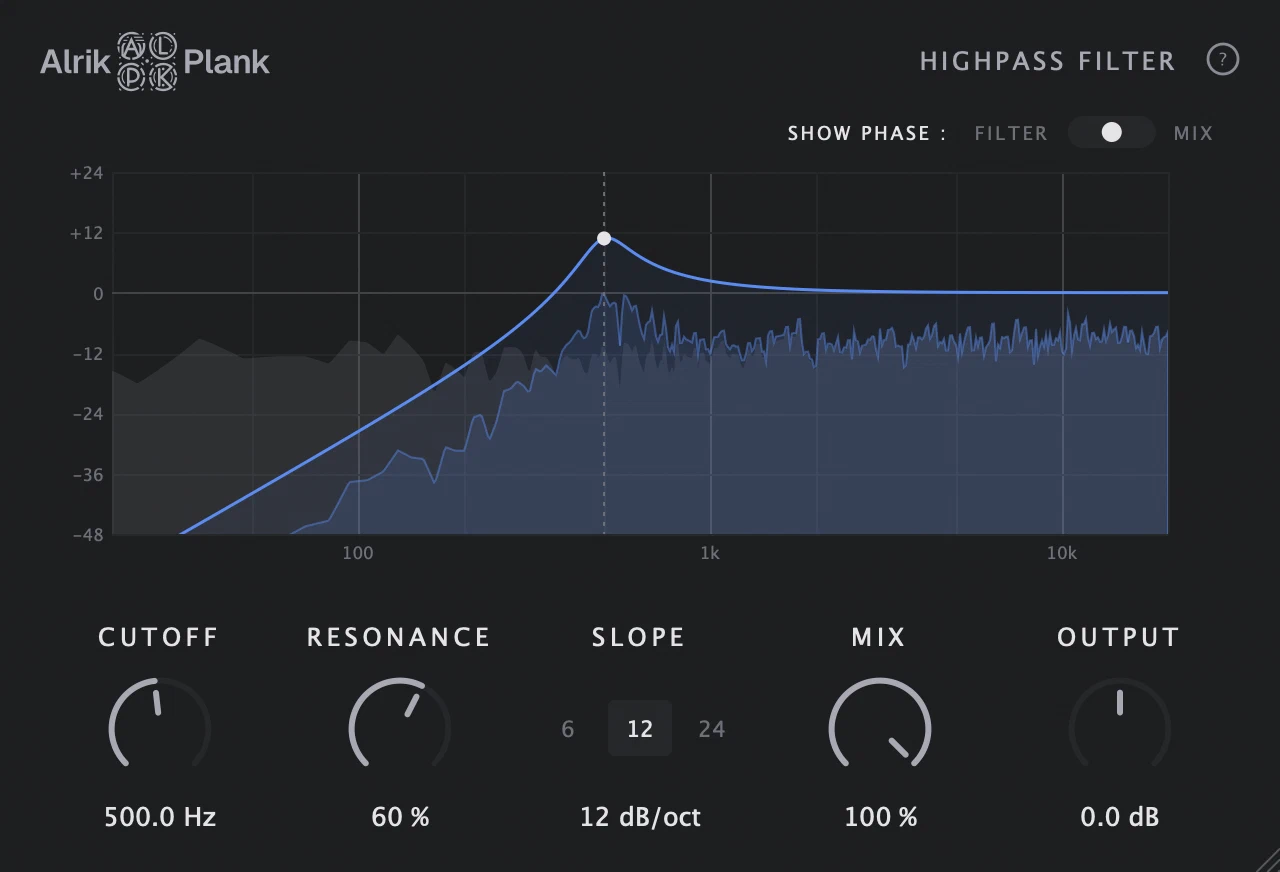
Showing the effect of phase shift on the output signal
With Mix under 100 %, Highpass also draws the effect of the phase shift on the gain. Here’s what it shows.
Let’s do a little experiment
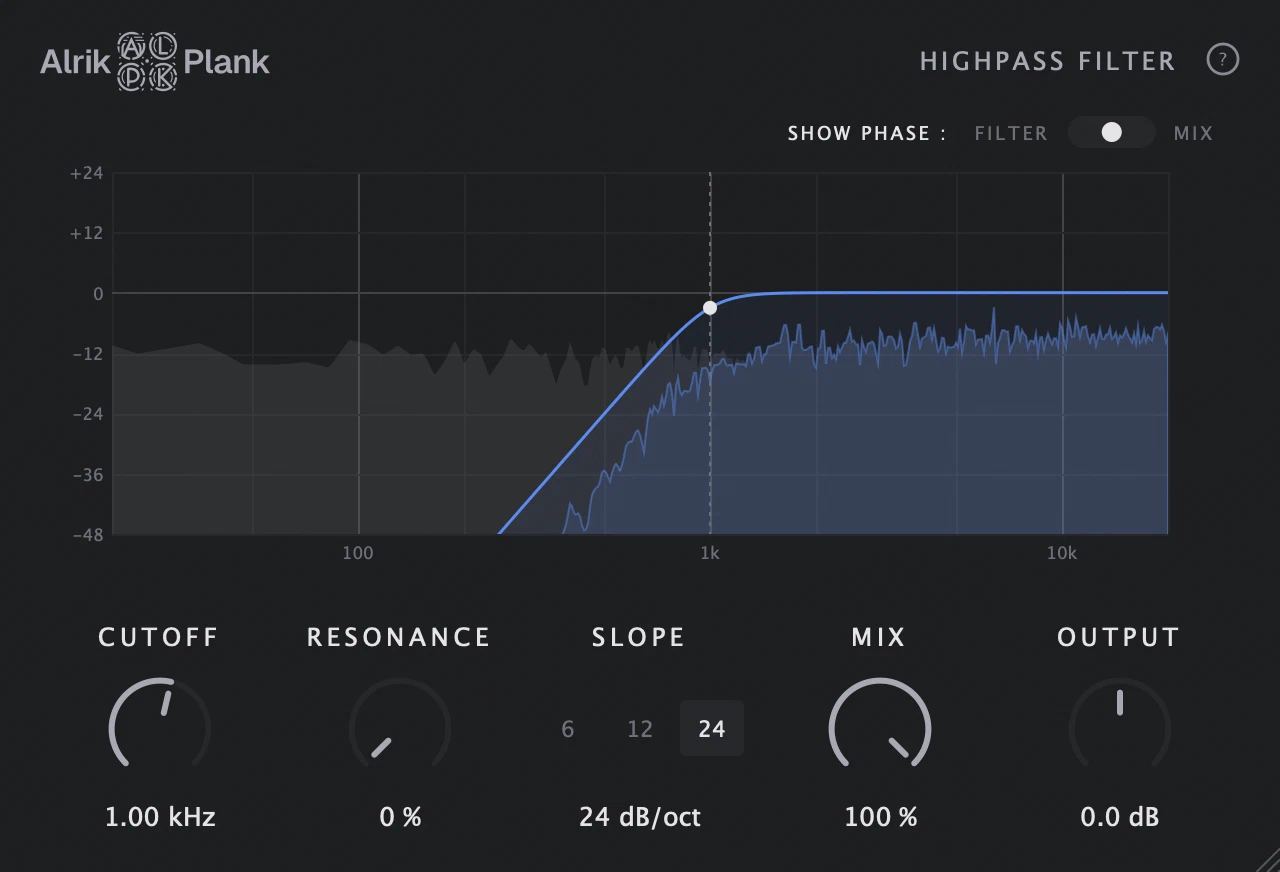
Set the cutoff to 1 kHz with a slope of 24 dB/octave (4th-order filter).
The maximum phase shift of this type of filter is 360°, with an exact phase inversion at the cutoff frequency. With Mix at 100 %, the output is only the filtered signal.
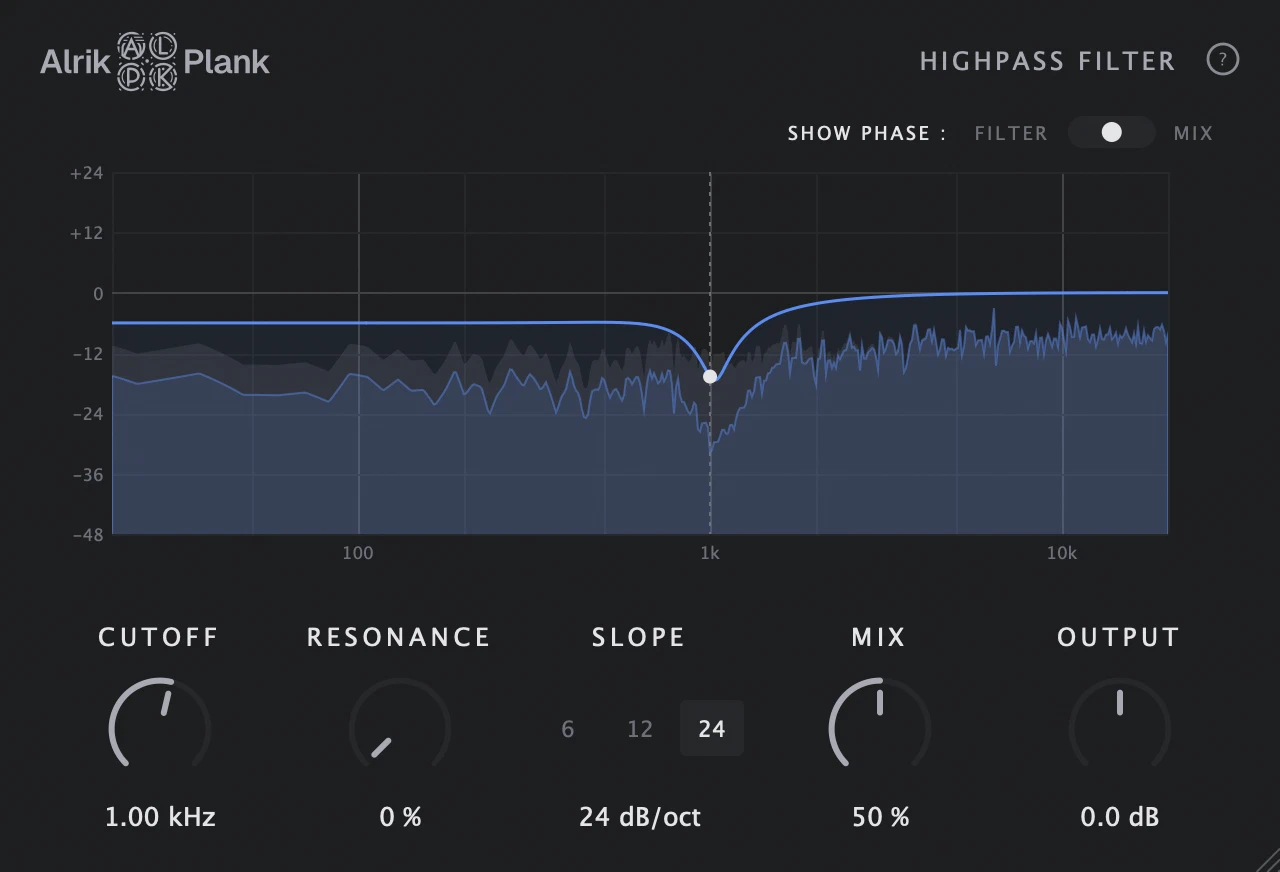
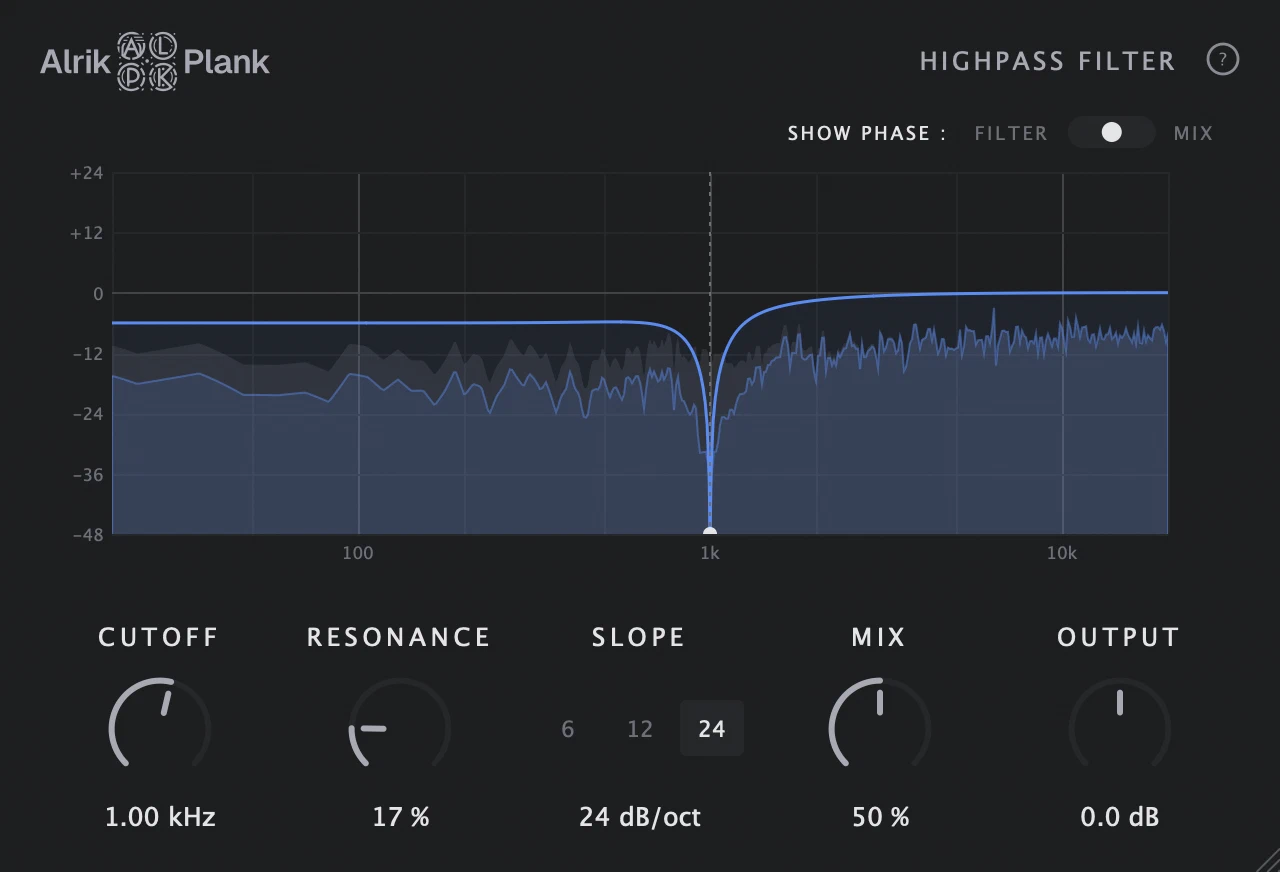
Now set Mix to 50 %. Half of the signal goes through the filter, the other half goes straight through, and the two are added. At the cutoff frequency, the filtered signal is shifted by 180°. Blending the original signal with the filtered one therefore makes a hole in the curve (about −17 dB here).
Why? The filter changes the gain with frequency, but it also shifts the signal in time (the phase shift)
Highpass is based on a classic digital filter, the same kind as in most commercial synths and EQs. These are called infinite impulse response (IIR) filters. They have no latency, but they don’t only lower the level of the signal at some frequencies: they also shift it a bit in time, and not by the same amount for each frequency.
At 24 dB/octave, right at the cutoff, the filtered signal is shifted by half a period (180°). When the dry wave goes up, the filtered one goes down. If you add the two and they have the same amplitude, they are in phase opposition: the signal is zero. At Mix 50 % they don’t quite have the same amplitude (at the cutoff, the filter has already lowered its signal by 3 dB), which is why the hole stops at −17 dB.
The Show phase switch displays the second part of a Bode plot, the phase shift versus frequency.
Using this flaw as an advantage
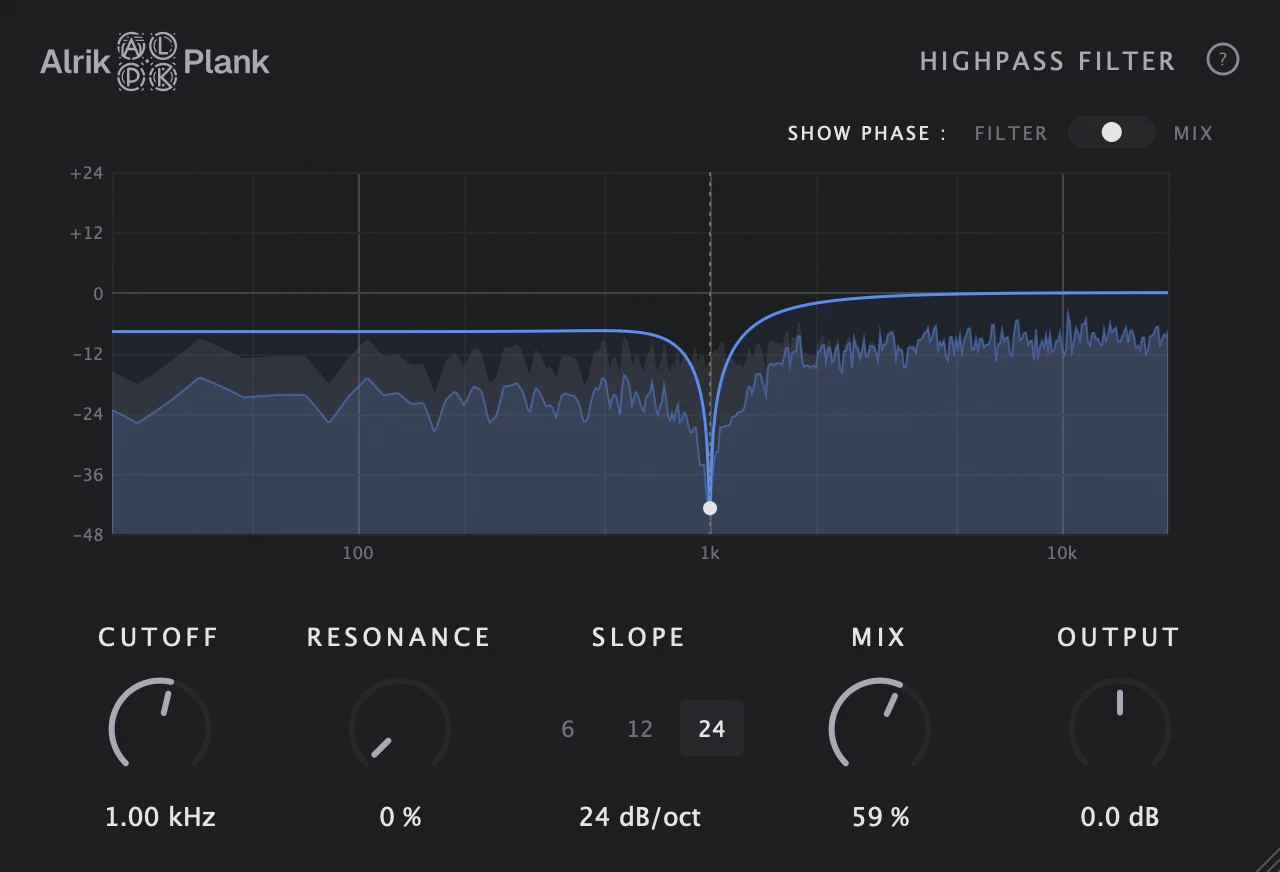
So there is a notch filter hidden in a highpass filter whose dry/wet balance you can set (Mix). With the slope at 24 dB/octave, there are two ways to get it:
- Mix at 59 %, Resonance at 0 %. At the cutoff, the filter lowers the signal by 3 dB (×0.707). With 59 % going through the filter and 41 % going straight through, both come out at exactly the same level, but upside down. They cancel completely and this frequency simply disappears. Below the notch, only the 41 % dry part is left, so the lows stay about 8 dB lower.
- Mix at 50 %, Resonance at 17 %. This time it’s the resonance that raises the filtered signal at the cutoff, until it reaches exactly the level of the dry one. Same result, a hole with no bottom. Below the notch, the lows stay 6 dB lower, like with any 50 % blend.
In both cases (with another filter plugin the values will be different), the Cutoff knob chooses the frequency to remove. You sweep it until the unwanted sound disappears.
In practice
It’s not a bug, it’s how these filters work. Analog filters work the same way, and the digital filters used here are a faithful copy of them.
And it’s not only with the Mix knob: each time you blend a filtered copy of a sound with the original (duplicated track, parallel bus, send with a filter), the same phase problems can show up.
- For a soft blend, use 6 dB/octave: only 45° of phase shift at the cutoff, so no hole.
- If a blend sounds hollow around a frequency, there’s probably a phase cancellation somewhere in the chain.
Linear phase filters don’t have this problem. They are built differently (finite impulse response, FIR), but they add latency and can smear sharp attacks. So it’s another compromise.