Dark Shimmer

Summary

Dark Shimmer is a shimmer reverb made for deep, dark pads: where usual shimmers rise into bright, airy pads, it takes your sound one or two octaves down. Freeze it into an endless drone and keep playing on top.

  • Free
  • Beta 0.1.4
  • macOS, Apple Silicon only
  • VST3
  • Not signed

Download

Preview

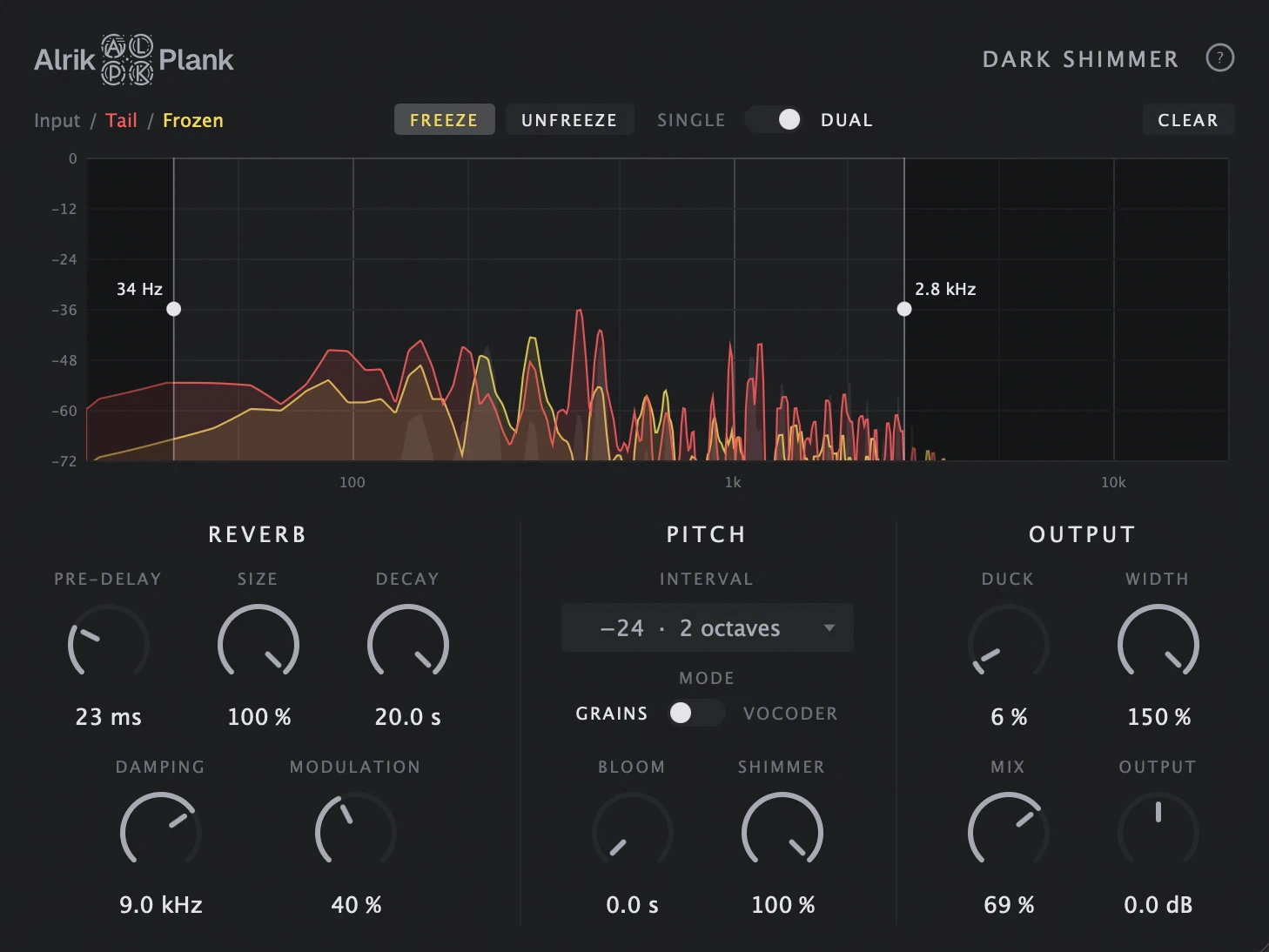
Dark Shimmer in Dual freeze mode, two octaves down with the Grains mode: spectrum of the live reverb tail in red and of the frozen drone in yellow, between band handles at 34 Hz and 2.8 kHz.

Features

How it works

Your sound goes through the reverb, as with any reverb. Part of the reverb is then taken one or two octaves down and added back into it: that is what makes the pad deep and dark. The coloured path shows this part. Freeze copies the reverb into a second layer, the drone (in yellow), which holds while you keep playing in Dual mode. Each box names the controls that act at that point.

direct soundcopied on FreezeDRONEfreeze · unfreezesingle / dualINPRE-DELAYbefore the reverbBANDlow / high cutREVERBsize · decaydamping · modulationclearWIDTHstereoDUCKdips as you playMIXdry / wetOUTPUTlevelOUTone or two octaves down,added back into the reverbPITCHinterval · modeBLOOMslow swellSHIMMERamount
direct soundINPRE-DELAYbefore the reverbBANDlow / high cutREVERBsize · decaydamping · modulationclearWIDTHstereoDUCKdips as you playMIXdry / wetOUTPUTlevelOUTone or two octavesdown, added backPITCHinterval · modeBLOOMslow swellSHIMMERamountcopied onFreezeDRONEfreeze · unfreezesingle / dual

Controls

Reverb

Pitch

Output

Freeze, Unfreeze and Clear (buttons above the spectrum)

Double-click a knob or a handle to reset it. The window can be resized from 75 % to 200 %; double-click the logo to go back to 100 %.

Limitations

Version info

Current version: 0.1.4 beta. For now it runs only on Macs with Apple Silicon (M1 and later).

It is not signed with an Apple Developer ID nor notarized by Apple, so macOS blocks it after download (see Installation below).

Download

Download Dark Shimmer 0.1.4

ZIP · 2.6 MB · VST3 plugin

SHA-256 6e696e5813a958cc3d655b1474ea699016afd4ac73a45bd4fb45b76c01f981d1

Installation

  1. Unzip the file and copy ALPK_DarkShimmer.vst3 to ~/Library/Audio/Plug-Ins/VST3.

  2. In Terminal, run:

    xattr -dr com.apple.quarantine ~/Library/Audio/Plug-Ins/VST3/ALPK_DarkShimmer.vst3
    
  3. Restart your DAW and rescan your plugins if needed. The plugin appears as Dark Shimmer, by Alrik Plank, in the reverbs.

Only do this for files downloaded from this site.

Release notes

Technical note

Grains or Vocoder: two ways to take a sound an octave down

Dark Shimmer takes part of its reverb one or two octaves down and feeds it back in. To do that, it has to change the pitch of a sound without slowing it down, which is harder than it seems: play a tape at half speed and you do get the octave below, but everything also lasts twice as long. The Mode switch lets you choose between two classic answers to this problem. They do not sound the same, and the reason is easy to see.

Grains: two read heads taking turns

The first method works like that tape played at half speed, but on a very short memory. The plugin keeps the last few milliseconds of sound and reads them back at half speed. The pitch drops an octave, but the reading falls further and further behind the sound coming in. So every 50 ms, the read head jumps back to the present and starts again.

A jump like that would click. To hide it, two read heads take turns: while one fades out before its jump, the other fades in, half a cycle later. The sound you hear is a chain of short overlapping slices of sound, or grains. This is the method of most shimmer pedals.

Its weak point shows on a single held note. A 330 Hz note, taken an octave down, should give a single line at 165 Hz:
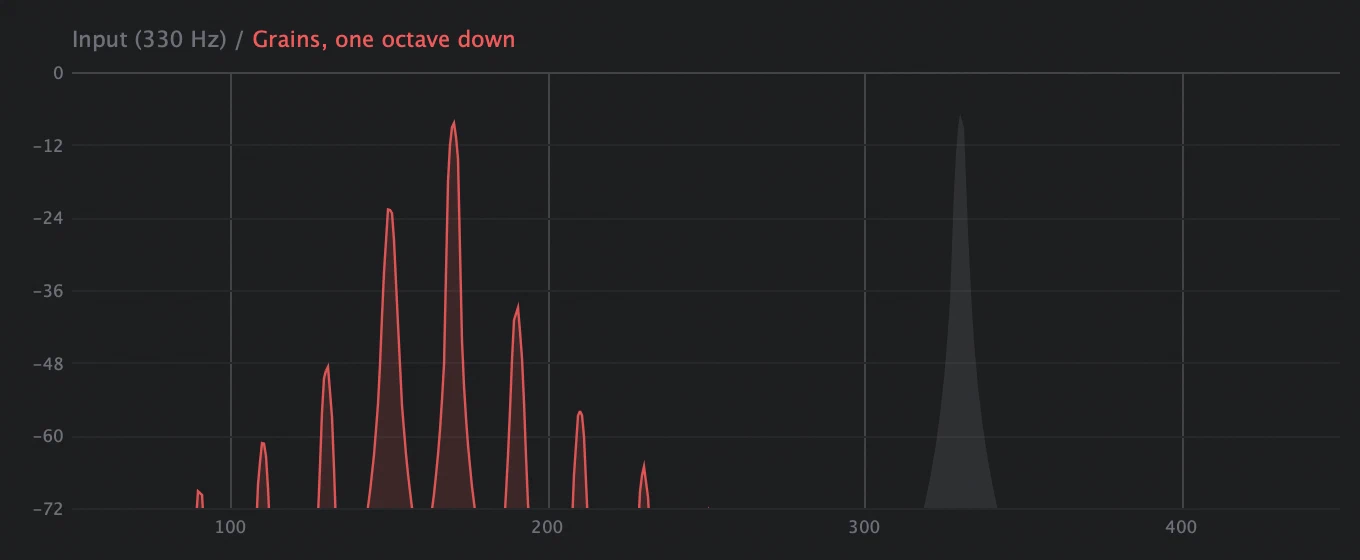
Measured spectrum of a 330 Hz sine wave through Dark Shimmer's Grains pitch shifter, one octave down: lines every 20 Hz between 90 and 230 Hz, the strongest at 170 Hz, the next one at 150 Hz only 7 dB below.
Grains: instead of one line at 165 Hz, a comb of lines every 20 Hz, the strongest at 170 and 150 Hz.

The note is rebuilt from slices that restart at a steady rate, and that rate leaves its mark: the sound is spread over a comb of lines spaced by the rate of the grains, around the note it should be. The ear does not hear several notes, but a note with a slight roughness and a fast flutter, a bit like a chorus. In a reverb, that roughness becomes movement: it is the lively, slightly grainy texture of classic shimmer.

Vocoder: taking the sound apart and putting it back together

The second method does not read the sound at another speed. It cuts it into short overlapping frames of 43 ms, measures which frequencies each frame contains (with a Fourier transform, the same tool as the plugin’s spectrum display), moves each one down an octave, then rebuilds the sound frame by frame. To keep the shape of each note intact, the parts of the spectrum that belong to the same peak move together, keeping their relationship. This is a phase vocoder.
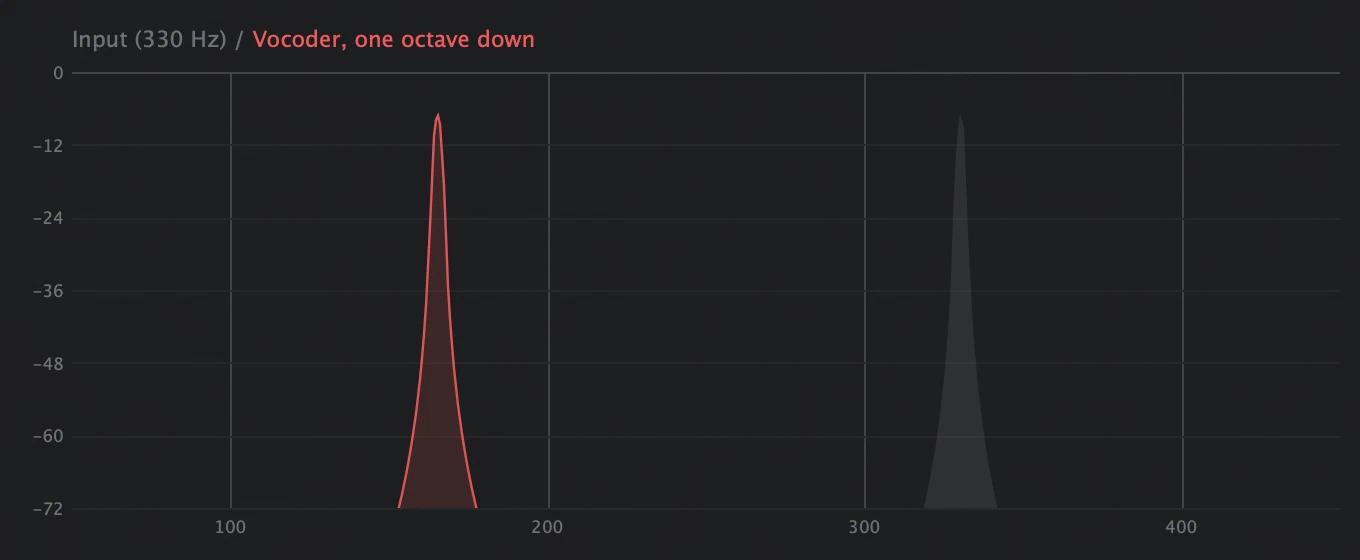
Measured spectrum of a 330 Hz sine wave through Dark Shimmer's Vocoder pitch shifter, one octave down: one clean line at 165 Hz, nothing else above -72 dB.
Vocoder: a single line at 165 Hz; whatever surrounds it is more than 40 dB below.

On a held note, the result is clean: one line, where it should be. Each note of a chord is moved on its own, and the pad gets smooth and stable, closer to an organ than to a pedal.

The price: time

The vocoder has a cost that does not show on a held note. To know which frequencies a frame contains, it has to wait for the whole frame. On a plucked note, the octave below only arrives after the attack has passed:
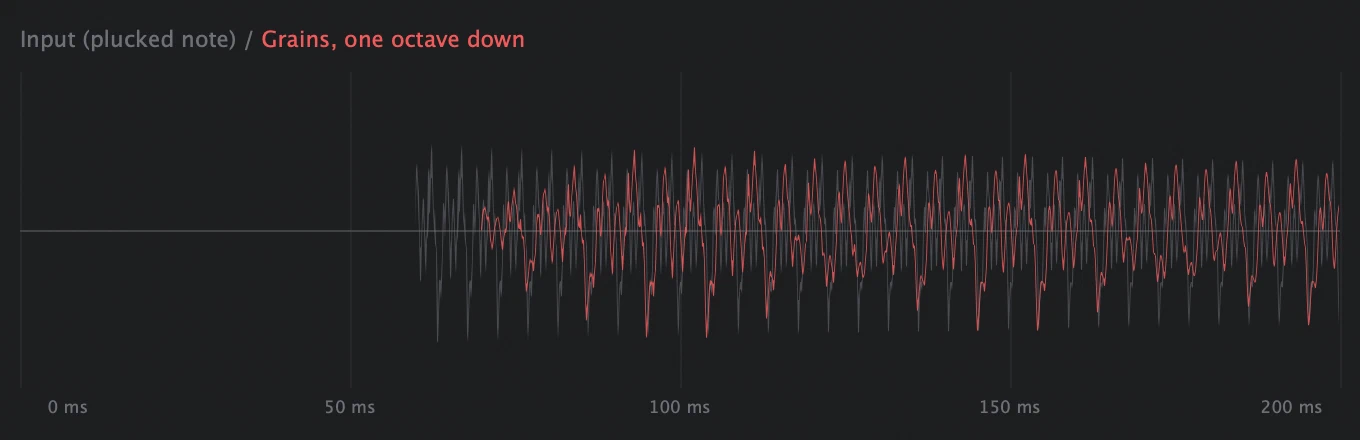
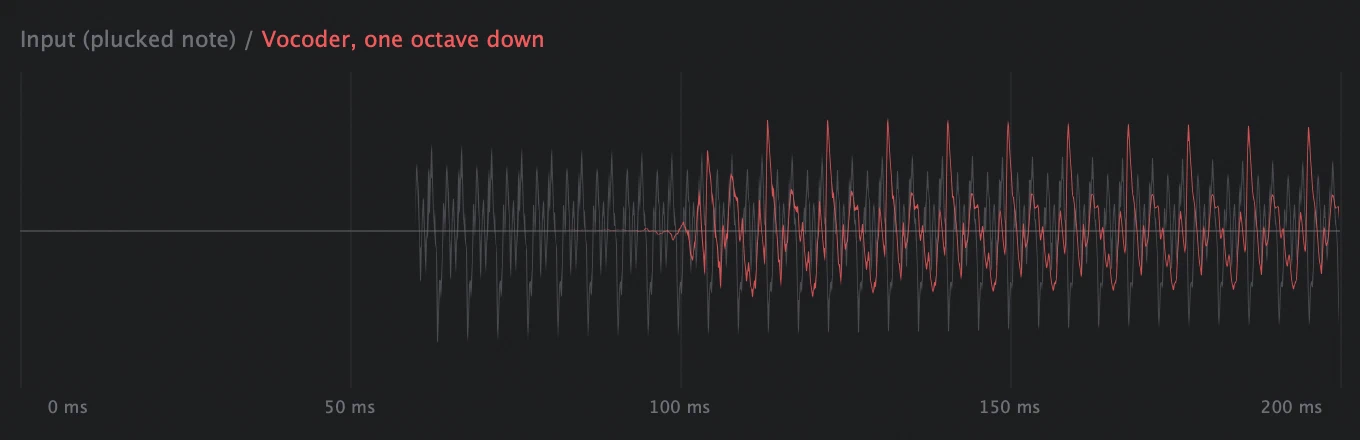
Waveform of a plucked note at 220 Hz (grey) and of its octave below through the Grains pitch shifter (red): the red trace starts about 10 ms after the grey one and its waveform is irregular.
Grains: the octave below starts 10 ms after the attack, with an uneven waveform.
Waveform of a plucked note at 220 Hz (grey) and of its octave below through the Vocoder pitch shifter (red): the red trace starts about 37 ms after the grey one, then repeats regularly every 9 ms.
Vocoder: it starts about 37 ms after the attack, with a perfectly regular waveform.

The read heads answer almost at once (their delay is 25 ms on average, but the head that happens to be just behind the present picks up the attack within about 10 ms). The vocoder answers late, and smoothly: the octave below comes in as a swell rather than a pluck.

Which one to choose?

  • Grains: for movement, a warm and slightly rough texture, the sound of shimmer pedals. The pitched part follows your playing closely.
  • Vocoder: for clean, still drones and held chords. It reacts more slowly, which in a reverb mostly makes the octave below swell in instead of striking.

In Dark Shimmer, the pitched sound keeps feeding the reverb, so the character of each method colours the whole pad, not just the attack. The best way to choose is still to switch Mode on a held chord and listen.

VST is a registered trademark of Steinberg Media Technologies GmbH.